
Workplace Burnout in India: Statistics, Causes and What Companies Can Do

According to the International Labour Organization (2024) report, an average Indian worker clocks 45.7 hours per week. The McKinsey Health Institute (2023) puts the share of Indian employees currently showing burnout symptoms at 59%, one of the highest rates on the planet.
What Is Workplace Burnout?
Burnout happens when someone is constantly faced with more demands than they can handle, for a long time, without enough time to recover or get help. It affects one’s feelings, thoughts, and work performance, and it doesn't go away after one good night's sleep.
Burnout is more than just being tired after a long week. Psychologist Herbert Freudenberger first used the word "burnout" in 1974 to describe a state of exhaustion that comes from too much and too long stress. The World Health Organization (WHO) now officially says that burnout is a work-related problem and not a personal flaw or a choice of lifestyle.
In India, this has become especially acute in sectors like IT, finance, and marketing, where 14-hour workdays are normalised and digital connectivity has quietly erased the line between office and home.
It is also worth distinguishing burnout from stress. A stressed employee still believes things could get better if they could just get on top of everything. That is no longer true for an employee who is burnt out. The exhaustion is deeper, the detachment is real, and no amount of willpower or short breaks closes that gap. That distinction matters because the solutions are different too.
What Are the Symptoms and Signs of Workplace Burnout?
Recognizing the symptoms of burnout is critical for early intervention. Because the Indian corporate culture often rewards "powering through," symptoms are frequently ignored until they manifest as a severe mental or physical crisis.
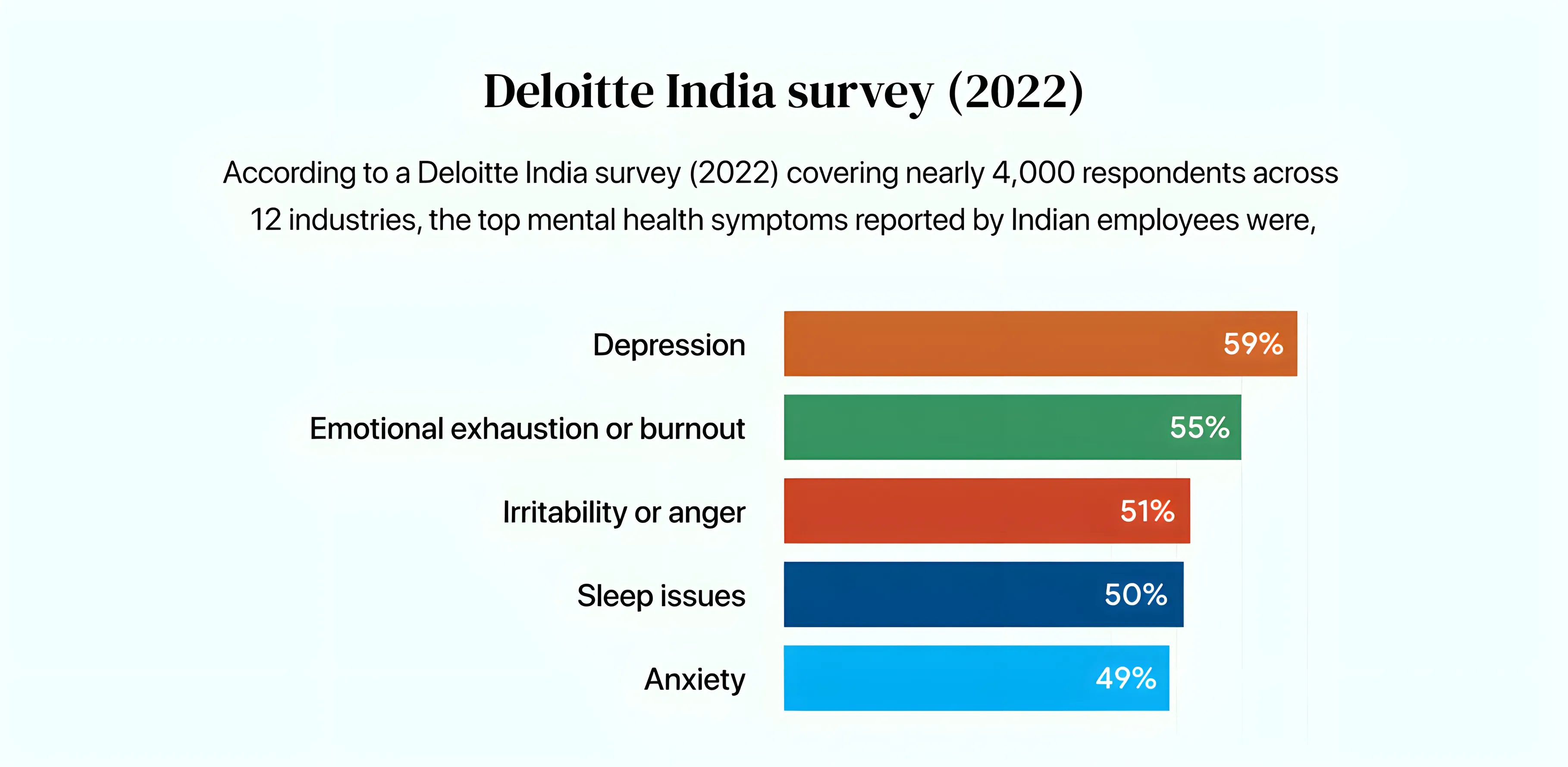
According to a Deloitte India survey (2022) covering nearly 4,000 respondents across 12 industries, the top mental health symptoms reported by Indian employees were: depression (59%), emotional exhaustion or burnout (55%), irritability or anger (51%), sleep issues (50%), and anxiety (49%).
Burnout present across four primary domains: physical, emotional, cognitive, and behavioral. If you or someone in your team is showing more than two of these signs consistently, it may be time to take it seriously.
Physical Indicators
The body often acts as the first alarm system for chronic stress. For many Indian professionals, these physical signs are dismissed as common ailments rather than symptoms of a systemic professional issue.
- Chronic Fatigue: An overwhelming sense of exhaustion that is not alleviated by a full night's sleep. Employees may feel tired before the workday even begins.
- Sleep Disturbances: Despite being exhausted, individuals may struggle with insomnia or interrupted sleep due to racing thoughts about work deadlines or unresolved tasks.
- Physical Ailments: Frequent tension headaches, muscle stiffness (especially in the neck and shoulders), and gastrointestinal problems are common.
- Weakened Immunity: Prolonged stress suppresses the immune system, leading to more frequent colds, infections, and a slower recovery time from minor illnesses.
Emotional and Cognitive Indicators
Burnout fundamentally alters how an individual processes emotions and handles mental tasks. This shift often leads to a decline in professional performance, which further fuels a cycle of stress.
- Emotional Detachment: A sense of being "checked out" or mentally withdrawn from team goals and interpersonal interactions.
- Cynicism: A hallmark symptom where the individual becomes increasingly negative about their work, their colleagues, and the company’s mission.
- Reduced Concentration: Chronic stress shifts the brain’s attention toward perceived threats (like a demanding boss or a missed deadline), making it difficult to focus on complex, creative, or analytical tasks—a phenomenon often described as "brain fog".
- Irritability: Small frustrations that were previously manageable now trigger intense emotional responses, often damaging workplace relationships.
Behavioral Indicators
As internal resources deplete, an individual's behavior at work and home begins to change, often as a dysfunctional coping mechanism.
- Withdrawal from Responsibilities: Taking longer to start tasks, procrastinating, or avoiding meetings and social interactions.
- Decline in Work Quality: Increased errors and a drop in productivity despite working longer hours.
- Substance Use: In many high-pressure Indian corporate hubs, there is a rising trend of using alcohol, nicotine, or even unprescribed sleep aids as a "silent" way to manage work-related anxiety and exhaustion.
The Rise of Burnout in India's Corporate Work Culture: Burnout Statistics in the Indian Workplace
The data regarding burnout in India suggests a systemic failure of current organizational models. Indian employees are among the most stressed and burned-out in the world, far exceeding global averages a pattern that the research literature consistently links to the country's culture of overwork.
According to the McKinsey Health Institute (2023), 59% of Indian employees are currently experiencing burnout symptoms placing India at number one globally, against a worldwide average of just 20%. This is not surprising when viewed alongside working hour data. South Asia has the longest average work hours in the world at 49 hours per week, and over a third of the global workforce already works beyond the 48-hour threshold (MHFA India's paper on Working Hours, Productivity, and Wellbeing Dwivedi et al., 2026)
The organisational cost is equally stark employee burnout drains the global economy of US$322 billion annually through turnover and lost productivity, while 40% of employees worldwide report feeling stressed for a significant part of their day (Gallup, 2025, as reviewed in Dwivedi et al., 2026). For India, these are not distant statistics. They reflect a workforce that is quietly running on empty.
Why Burnout Is Rising in India's Corporate Sector
Burnout in India does not have a single cause. It is the product of a complex web of cultural, organizational, and systemic pressures that have intensified over the past decade.
1. A Culture That Glorifies Overwork: When leaders publicly called for 70–90 hour workweeks, it normalized overwork as dedication.
2. Blurred Work-Life Boundaries: Work no longer has an off-switch. The always-on culture, where employees are expected to remain available well beyond contracted hours, is not merely a habit, it carries measurable health consequences. The WHO/ILO (2024) links chronic overwork to a 35% higher stroke risk and a 17% higher risk of heart disease.
3. Job Insecurity and Performance Pressure: Fear of layoffs and AI-driven restructuring keep stress chronically elevated. Manager engagement across South Asia fell eight points between 2024–25, tied to hiring slowdowns and mid-level cuts in India's IT sector. (Gallup, 2026).
4. Weak Mental Health Infrastructure: Mental health infrastructure in Indian workplaces remains thin. According to Mpower's 2023 Mental Health and Wellness Quotient survey of 3,000 corporate employees, only 1 in 10 employees have access to professional care. Even where organisations offer mental health benefits, uptake of formal support counselling, mental health check-ups, wellness programs remain limited, with stigma as the primary barrier.
5. Gender Disparity: Burnout hits women harder. 37% of female Indian employees cite poor work-life balance as their top reason for wanting to quit, compared to 28% of male peers — reflecting the double burden many women carry at work and at home. (Healthcare Radius, 2024)
Why Employers Need to Focus on Workplace Burnout
Burnout is often framed as an individual problem, something an employee should "manage better." But the evidence tells a different story.
Costs Companies Significantly
Deloitte India's 2022 report found that poor mental health costs Indian employers US$14 billion per year through absenteeism, presenteeism, and attrition. Every rupee not invested in prevention becomes a much larger bill later.It drives talent out. Among the Deloitte survey's respondents, 20% had already resigned to cope with their mental health; a significant retention risk at a time when talent is India's greatest competitive asset.
Suppresses Productivity
An employee experiencing burnout is physically present but mentally absent — a phenomenon called presenteeism. MHFA India's paper on Working Hours, Productivity, and Wellbeing (Dwivedi et al., 2026) found that long working hours consistently lead to a decline in output and organisational performance. The research shows there is an optimal ceiling to productive hours: beyond approximately 49 hours a week, additional time at work actually reduces total output rather than adding to it.For every 10% increase in overtime, productivity falls by 2–4%. Workers experiencing fatigue from prolonged hours lose an average of 4.1 productive working hours per week due to impaired focus and the greater time needed to complete tasks. In short, longer hours do not produce more — they produce less, and at a higher human cost.
Leadership Responsibility
When organizations normalize extreme work expectations, they create conditions for burnout. The inverse is also true: companies that build cultures of psychological safety and recovery consistently report higher engagement, lower turnover, and stronger innovation.
How to Manage Burnout at Work
For individuals already experiencing burnout, recovery requires intentional steps — and ideally, organisational support.
- Acknowledge it first. Burnout thrives in silence. Recognising what you are experiencing and naming it is the first step. Reaching out to a trusted manager, colleague, or mental health professional matters.
- Set boundaries on working hours. Avoid responding to messages beyond your contracted hours. Switch off notifications. Protect your personal time as you would a meeting. If your workplace culture makes this feel unsafe, that itself is a systemic signal worth raising.
- Use recovery time deliberately. Breaks, annual leave, and weekends are not luxuries — they are biological necessities. Use them to genuinely disconnect.
- Seek professional support early. Many Indian cities now have accessible online counselling through platforms and organisations. The earlier you seek help, the faster the recovery. Do not wait for a crisis.
- Talk to your manager. Request a workload review or discuss deadlines. A supportive manager can make a measurable difference. If your organisation has mental health resources, use them — they exist for this purpose.
How to Prevent Employee Burnout
Prevention is far more effective and far less expensive than recovery. Here is what evidence-based prevention looks like in the Indian corporate context:
For Organisations:
- Establish and enforce clear working-hours norms, including a “right to disconnect" after hours.
- Conduct regular anonymous standardized surveys to understand how teams are actually feeling.
- Train managers and HR teams in MHFA to recognise early signs of burnout and respond supportively.
- Build formal mental health policies rather than relying on ad-hoc goodwill.
- Reward outcomes, not hours; shift from a culture of presence to a culture of performance
- Create safe channels where employees can raise concerns without fear of judgement
For Managers:
- Hold regular one-on-one check-ins that go beyond task updates
- Model healthy behaviour — take your own leave, log off on time, and speak openly about pressure
- Redistribute workload equitably and flag resourcing gaps upward
- Normalise conversations about wellbeing as a regular part of team life
For HR Leaders:
- Integrate mental health into onboarding, performance reviews, and exit interviews
- Move beyond one-time awareness events to sustained, skills-based support
- Track metrics: absenteeism rates, attrition, engagement scores, Access to Professional care utilisation
How Wellbeing Programs and MHFA Reduce Workplace Burnout
The most effective wellbeing programmes go beyond yoga sessions and helpline posters to build real human capacity within organisations. Mental Health First Aid (MHFA) is one such evidence-based approach equipping employees, managers, and HR professionals with practical skills to:
- Recognise early signs of mental distress
- Initiate supportive conversations
- Guide colleagues toward professional help before situations escalate
It is not therapy. It is human connection, backed by evidence, and scaled across the workplace.
MHFA India's impact data:
According to MHFA India's impact data (2018–2024), trained workplace participants showed:
- 81.2% improvement in help-seeking attitudes
- 78.5% improvement in information-seeking knowledge
MHFA India's analysis of secondary research also points to a compelling return on investment: workplace mental health initiatives deliver approximately US$2.86 in benefit for every US$1 invested. Organisations that implement MHFA training consistently report 20–25% reductions in absenteeism and measurable improvements in retention.
The evidence on working hours reinforces this further. MHFA India's paper on Working Hours, Productivity, and Wellbeing (Dwivedi et al., 2026) — a systematic review of 29 global studies — found that reducing working hours with no reduction in pay improves employee wellbeing and either maintains or increases productivity. The paper proposes that wellbeing mediates the relationship between working hours and productivity: when overwork erodes wellbeing, productivity falls as a consequence. This makes the case for investing in wellbeing not just as a moral imperative, but as a direct driver of organisational performance.
The WHO and ILO's Joint Policy Brief (2024) reinforces that the solution to overwork and burnout must be multi-stakeholder: governments enforcing working-hours norms, employers designing healthier work cultures, and organisations building internal capacity to respond early. A trained MHFAider present in the team, trusted by colleagues sits at the heart of that internal capacity.

Conclusion
Burnout in India is a design problem built into how work is structured, how hours are measured, and how rarely organisations ask whether their people are actually okay. The data is clear, the cost is quantifiable, and the solutions exist. What is missing, in most workplaces, is the decision to act before someone breaks. Investing in that decision, through policy, through training, through culture is what sustainable performance actually looks like.
➡️ Ready to Build a Burnout-Proof Workplace? Join organisations across India that have trained their teams with MHFA India. The decision to act starts here. Register for MHFA Workplace Training →
Sources:
- McKinsey Health Institute Global Survey, 2023
- Deloitte India — Mental Health and Wellbeing in the Workplace Survey, 2022
- International Labour Organization (ILO) Report, 2024
- WHO/ILO Joint Policy Brief on Mental Health at Work, 2024
- Indian Journal of Psychiatry — Mental Health and Wellbeing at the Workplace, 2024
- Gallup State of the Global Workplace Report, 2024 & 2026
- MediBuddy-CII Report on Employee Burnout, India
- MHFA India Impact Report, 2018–2024
- NIMHANS National Mental Health Survey, 2015–16
Frequently Asked Questions (FAQ's)
What are the top-rated corporate wellness programs that address employee burnout?
Leading burnout programs in India prioritize prevention by integrating MHFA training, stigma-free professional care, and psychological safety protocols for managers. These initiatives address the root causes of exhaustion through realistic workload policies rather than relying on reactive, one-off workshops. This holistic approach ensures a sustainable, proactive culture that supports long-term employee well-being.
How can I access online support groups for professionals experiencing burnout in India?
You can reach out to Tele-MANAS on 14416 . It is a free, 24/7 government helpline that connects you to trained counsellors near your region. Your workplace may also have trained MHFAiders who offer peer support as a first step.
What are the symptoms of workplace burnout in high-pressure jobs?
Common signs include constant exhaustion, emotional detachment, and reduced performance. People may also face frequent errors, sleep issues, or physical symptoms like headaches. Many professionals also report anxiety, low mood, and irritability.
What is the most common cause of employee burnout?
The biggest cause is sustained workload without enough recovery or support. In India, workplace stress is a leading factor affecting mental health. Long hours, blurred boundaries, and lack of recognition make it worse.
Is burnout a personal problem or a workplace problem?
Burnout is primarily a workplace issue, not a personal failure. The World Health Organization defines it as an occupational phenomenon. Real solutions need changes in how work is designed and managed.
What are the five symptoms of burnout?
Burnout often shows up as exhaustion, detachment, and reduced performance. It can also include physical issues like poor sleep and frequent illness. Emotional changes like irritability or numbness are also common.
How does stress and burnout at the workplace affect a person?
Burnout affects mental, physical, and social wellbeing. It increases risks of anxiety, depression, and even heart-related issues. It also impacts work through lower productivity, errors, and higher absenteeism.
Why do so many people burn out at work?
Burnout happens when demands consistently outweigh support and resources. In India, long hours, constant availability, and job pressure play a big role.